Resources
Feeling some deep down chill? Click for this soup specifically designed to offset that Qi cool
Want to prepare for outdoor activity? Training Outdoors in the Cold, Dry High Desert of Flagstaff, AZ
Explore the Concept of Yin and Yang with Qi at Depth
Looking for Our Extensive Qi Gong Library –>Here
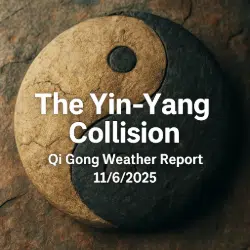
Qi Gong Weather Report – December 6, 2025: Summary
1. Overall Qi Pattern
The qi has returned to relatively normal after an abnormal, turbulent start to fall.
Energetically, this is a transitionary period moving from the remains of autumn yang toward early winter yin.
2. What This Means for the Body
The body wants to condense, fold inward, and reduce outward expenditure.
You should allow restfulness, but avoid falling into full inactivity.
Too much stillness pushes you toward a deep yin state, which is not appropriate yet.
3. Avoid the “Mushroom Phase”
A humorous but accurate description:
“We’re not mushrooms.”
Don’t drop into heavy, inert yin (like a plant hiding underground).
Maintain a moderate amount of activity to keep yang engaged.
4. Emotional Tone
Most people feel a noticeable contemplative mood.
The mind naturally turns inward during this early-winter shift.
Emotional qi becomes softer, quieter, but not depressive — just reflective.
5. Energetic Caution
Rest is good; withdrawal is not.
Excessive yin at this stage leads to sluggishness, stagnation, or emotional flatness.
Think: gentle condensation, not collapse.
6. Practical Advice for Today
Allow rest without fully disengaging.
Keep light, consistent activity in your schedule.
Support the body’s natural shift by staying warm, staying loose, and staying moderately active.
7. Seasonal Alignment
This pattern reflects a normal descent into winter yin after an unstable lead-in earlier in the year.
The current qi supports:
Emotional preparation for stable winter yin
Physical preparation (warming, conserving, stabilizing)
Qi preparation (gathering, condensing, internalizing)
8. Key Takeaway
The qi invites gentle inwardness — not hibernation. Rest, but don’t disappear.
This is the time to gather yourself, keep a touch of yang alive, and prepare your emotional and physical systems for deep winter stability.
Carry your practice beyond the mat.
The Refined Qi Gong Collection blends stillness and style — inspired by the same principles you train with.
Does Master Steenrod Know What He’s Talking About?
by Hal Winthrop
Every now and then, a listener asks me whether Master Steenrod’s readings of the qi—especially these seasonal Weather Reports—line up with what we know from traditional texts and modern physiology. The short answer is: yes, they do. The slightly longer answer is a lot more interesting.
Let’s take today’s theme: the body condensing as we enter early winter, and the reminder that we should rest—but not collapse into full inactivity.
That idea isn’t improvisation; it’s as old as Chinese medicine itself.
1. Classical Roots: The Suwen (黄帝内经素问) Sets the Pattern
The Huangdi Neijing, sometimes called the Yellow Emperor’s Inner Classic, opens its entire medical and seasonal section with a simple principle:
“In winter, things return to their root.” (Suwen, Chapter 2)
Winter yin is described as a time when both qi and spirit draw inward, like sap returning to the core of a tree. The instruction is to conserve rather than expend, but not to stop living altogether. The same text warns against sinking into torpor:
“To contradict the qi of winter is to injure the kidneys.”
Translation for modern ears:
Don’t fight the season, but don’t turn yourself into a log either.
Master Steenrod’s comments about humans not being “mushrooms”—in other words, not withdrawing into deep, inert yin—fit this classical guidance perfectly. The ancient authors didn’t want you sprinting marathons in December. But they also didn’t want you melting into the couch.
2. Other Traditions Agree: Yangsheng, Daoist Practice, and Even Martial Sources
Han and Tang dynasty yangsheng (nourishing life) texts give nearly identical advice:
rest, reflect, and quiet down—but maintain gentle, consistent movement so the qi doesn’t stagnate.
Daoist practice manuals go further. Many warn that too much stillness in early winter can cause:
heaviness in the limbs
dullness in the mind
emotional flatness
These are almost word-for-word matches to what Master Steenrod describes as the hazards of dropping into “deep yin” too early.
Even martial texts, like Chen-style winter training guides, emphasize short, moderate practice sessions that maintain body heat and momentum without exhausting the system.
So yes — across the entire classical spectrum, this reading is remarkably consistent.
3. Modern Physiology? Surprisingly Sympathetic
Today’s researchers may not talk in terms of yin and yang, but they observe something similar when they look at seasonal transitions.
Studies from Chronobiology International, the Journal of Physiological Anthropology, and Harvard’s seasonal mood research have found that:
People naturally experience reduced outward drive entering winter.
Parasympathetic activity increases, meaning the body leans toward recovery and inward focus.
Over-resting can lead to lower motivation, decreased circulation, and mood flattening.
That last point is straight from the qi gong playbook. Too much yin too early?
Modern biology sees similar effects.
Master Steenrod’s suggestion to stay lightly active, even if you feel contemplative, lines up nearly one-to-one with these findings.
4. The Emotional Weather Checks Out Too
The episode notes that people may feel more reflective or quiet right now — not sad, not withdrawn, just gently inward.
Again, this mirrors both the Suwen and current psychology research, which show:
Seasonal energy naturally shifts cognition toward introspection.
People often report more “mental spaciousness” or quiet, not depression.
Ancient or modern, the pattern holds.
5. So… Does He Know What He’s Talking About?
From where I’m standing — drawing on classical texts, qi gong lineages, yangsheng literature, and modern physiological studies — yes.
The structure behind today’s Weather Report is consistent, historical, and surprisingly well supported across disciplines.
He’s not channeling personal mood or intuition; he’s tapping into a very old conversation about how humans relate to the seasons, what the body is built to do, and how qi responds as the year turns inward.
The main message is the same whether you read a Han dynasty physician or a contemporary chronobiologist:
Rest is right. Collapse is not. Stay warm, stay loose, stay gently moving.
And honestly? That’s the kind of winter advice most of us could use.